
Handed
I had tested games. I had never made one.
Seventy-two hours, six people I had not met, scattered across time zones, and I was producer and one of the four writers at the same time. Mostly narrative designers (didn't know games needed those, at the time). One artist. One composer. The theme arrived with the clock: resilience.
A hundred and twenty-three teams started when we did.
Two roles is a conflict before it is ever a convenience. The person keeping the schedule is the one whose pages get cut, and on night one nobody had decided anything: not the scope, not the tone, not who was good at what.
Decided
Four calls. The first one I made alone.
I mapped everyone's availability across the seventy-two hours before the creative work started, then facilitated ideation loose on the first evening and let the room breathe. While the team diverged I was building a single source of truth board, the personas, and the audience frame within Arcweave, the engine tooling we were using. We stormed late into the night, and the design grew richer in substrate.
The next morning, I put it on the board and opened our standup with it: this is who we are designing for, and if you think it should change, say so; it is a living board. The read was that our judges are narrative designers, and that a good number of them were living through the same layoff cycle the theme was fishing in. They did not need bombast. Nobody pushed back.
The team had scoped three days of story. I cut it to one. The precision we needed between hardship and kindness does not survive being spread thin, and three days of mediocre is worse than one day of exact. The pivot went over well.
And last, I wrote down how a choice works and then stopped approving them. Never win or lose: a choice has to build toward grit, improbable belief, or emotional realism, and the right one depends on who you are talking to. Doing nothing counts. Listening counts. Leaving counts. The six of us then wrote toward the same thing without a sign-off loop, which is the only reason we finished at all.
Shipped
A playable narrative game, submitted inside the window.
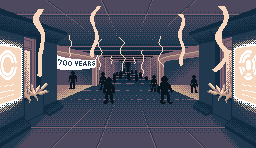
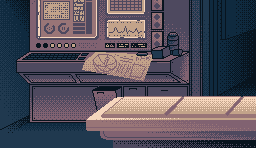
You are Mendez, the new wellness officer aboard a space colony, the SS Ozymandias, for a day. Three or four of the ship's passengers will need something from you, as a soothsayer. The medic you play is apathetic, short-spoken and satirical, and the narrator who describes him is reflective and a little kinder than he is. He is more than he performs; though, player choice composes his exact narrative arc in a playthrough.
The thesis underneath it: resilience as peaceful acceptance of present hardship instead of despair, with a hope of coming out stronger.







Outcome
Second of a hundred and twenty-three, and Excellence in Game Writing, at the IGDA Game Writing SIG Arcjam 2025. Perfect scores from both judges who scored us, Jon Myers and Frankie Wakefield-Harrey. Nominated for Excellence in Narrative Design.
Six people assembled, delivered and dissolved inside three days, with no history and no future, and worked better than teams I have been on for months. That became the ever-pressing research question I am still following.
Would change
Log the reasoning, not only the board.
The single source of truth existed from the first hours, with the availability map and the personas beside it. None of them records why. What I believed at hour twelve against hour sixty, and which of the four calls above I doubted, is not on record; the account of each here was written from memory, months later.
The artifacts prove the work happened. The reasoning is what proves the judgement. Every project since logs the decision when it is made, and that habit starts here.
Edges
- Telling the Bees ~ the same two roles across six weeks, not three days. What scaled is in this entry; what did not is in that one's Would change.
- Governance by artifact. The board and the choice rule are one move made twice: put the decision somewhere contestable and stop being the approval step. It is the move I have reused most.
- The team is the research. A short-duration, high-cohesion group that forms, ships and scatters ~ recognised as a question months afterwards, which is the honest order.
- Provenance. The game and the juried record are the jam's own. The decisions are recalled ~ see Would change, which is the point.