Handed
In September, LeeAnne asked me to take over social media for her college-admissions coaching practice. She called it not great, and the diagnosis was precise: nothing was missing but hours. She had a brand kit, a template library, a newsletter platform, a mailing list, and admissions data she reads better than anyone I know; social simply sat at the bottom of her list.
I had edited her students' essays since June, so I already had her brand register down pat, and she had introduced me to her team as editor and operations manager. Her brief was specific: four content pillars with examples, mapped to platform and audience, inside eight hours.
Decided
The strategy rests on one claim from social psychology: competence gets a practice considered, but only warmth gets it recommended. A coaching practice grows on recommendation, so every decision served warmth, and the four pillars answer the three questions a family asks of an expert ~ is she good, is she honest, is she on our side.
Ownership. She kept brand approval and the final say; I took strategy and execution. Her own distinction decided it: the difference between a qualified student and a desired one, which an agency would never know and on which the whole strategy hangs.
Values without party. I proposed using her admissions data with an edge, an implied argument for education. She overruled me, rightly. Her families span opposed politics, and she may be the only adult who can reach a given student. We settled on values-forward and openly inclusive, which keeps every reader whose mind is not yet made up.
The audience the data found. Before locking the plan, I read 274 days of her platform export. Her readers are mostly women aged 35 to 54 in and around Fort Worth; students barely register. Views ran healthy and clicks rare, which marked the accounts as the place families go to check her out once someone has recommended her. Parents became the audience and students the subject, and posting frequency, which the research shows does not move engagement, left the plan.
Her brief, first. A broader growth design came early, and it was good thinking for a larger job. I set it aside and built the four pillars she had commissioned, inside her eight hours.
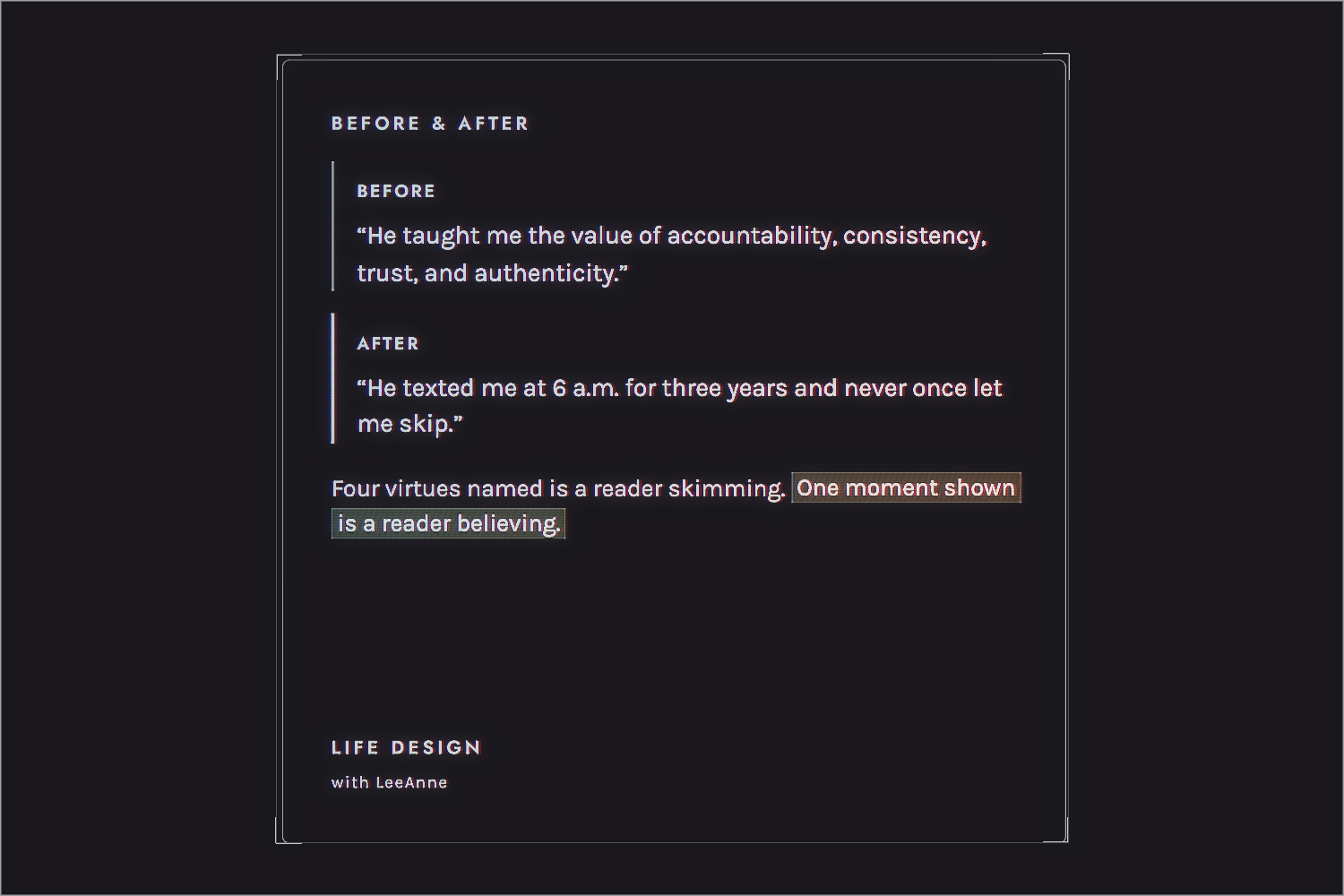
Before & After. The third pillar shows a real student line as it arrived, the edit, and the principle behind it. Its material arrives every week from the editing I already do, and no competitor can copy it without doing the editing.
Shipped
On 2 October: four pillars with real examples, each mapped to platform and audience; eight posting rules on a page of their own; a costed eight-hour month; a table of what follows from each of her open decisions; and a plain-English release that gates every post about a student. All of it in her palette, and written as a team ~ our accounts, never yours.
Cut: the admissions-data pillar, folded into the others as evidence; TikTok, for this year; and a storefront idea outside my expertise.
Outcome
The finding that decided the strategy: everything only she could post was already written. Her boot camp tells families on its first day that a no matters as much as a yes, and its third day lays out a complete junior-year timeline. The work became publishing what we had already made.
Her history had already proved the model. One mother in Cincinnati, a thousand miles outside the market, whose son got into Penn, has sent students every year since, on no marketing.
She paid the hours two days after delivery, and the first month needs nothing further from her.
Would change
Build the commissioned piece first. She asked for four pillars in eight hours, and a scope document and the growth design came before them. Both fed the pillars, and both could have followed them. The client's brief sets the order; the larger thinking earns its place after it.
Evidence
Her figures stay out, apart from the shape of her own account. The published work behind the strategy does not.
- Warmth over competence. Cuddy, Fiske and Glick: warmth predicts active help and competence only passive help. A recommendation is active help.
- The three questions. Hendriks, Kienhues and Bromme: lay readers judge an expert separately on expertise, integrity and benevolence.
- Frequency against followers. Posting frequency showed no effect on any platform in the regression; follower count was the strongest predictor at every level.
- Hashtags, left open. Gkikas et al. report strong hashtag correlations on Facebook organic; Sörensen et al. report null. The posting rules lean on the study of roughly fifteen thousand posts over the one of a hundred and thirty-five, and say so.
- Readability is conditional. Yu, Hong and Egger find caption complexity depresses engagement depending on image type; pooled across types, the effect washes out.
- A paper's abstract against its tables. Gkikas's abstract asserts a combined finding its tables support only in part ~ hashtags strong, length moderate, readability marginal.
- Why reputation is the market. Dulleck and Kerschbamer on credence goods: where buyers cannot verify the outcome and purchase once, reputation that spreads is what makes the sale possible. The Cincinnati family is that mechanism, observed.
Edges
- Sworn ~ the other professional engagement. That one is governance for a product team; this one is a communications function inside a small practice where I am most of the capacity.
- Credit where it is owed. The qualified-versus-desired distinction, and the call to keep party politics off the page, are both hers.
- The consent gate. The content that would perform best needs a minor's permission, so the release came first, and it shaped the strategy more than any platform decision.
- Provenance. Written from the engagement's call summary, its decision trail and its six build and deliverable records. The abstraction note says what is deliberately absent.