Handed
About five years ago, a Yuumi attached to my Jarvan and farmed my jungle.
She rode along, waited for a camp to drop to critical, detached to take the last hit and the experience, reattached, moved to the next one. While I was dead she healed and shielded everyone but me. The moment I respawned she returned. The enemy jungler reached level nine; I was around two.
Attaching is Yuumi's design. Detaching is legal. Last-hitting is legal. Nobody broke a rule, and neither of us typed a single word, so nothing reached the channel the system reads. That absence is the evidence.
Then I tried to suicide into the enemy team to get her killed. The ban was automatic.
Decided
Four calls, and each one moved the paper from the troll to the institution.
The position, not the person. Motive research on trolls is abundant, and you cannot ship an intervention against an intention. So I studied the position I was standing in: what it costs the one player who can see what is happening and is required to assume otherwise.
A name, not toxicity. Riot's own glossary refuses that word as unspecific, and it would have handed me a literature built on chat logs, which is the solved case. So I named the thing. Mimetic incompetence: defection whose signature is indistinguishable from ordinary error to a classifier, while becoming probabilistically legible, across forty minutes, to the teammate beside you. I took the title from the mechanical fact the casters reached by elimination, about a professional's aborted ultimate ~ he cancelled it. What they said about his motive was separate, and prescribed: you have to give him confidence it was just a misplay. That prescribed charity is the shelter the whole thing operates under. Huizinga offers a cheat, who pretends to be playing and still acknowledges the circle, and a spoil-sport, who ignores the rules and withdraws. She is the cheat, I am the spoil-sport, and the merger is mine; Riot inherited the same two and has no name for the hybrid either.
The rule, not the detector. No rule had been broken, so the obvious question was why the system could not see it ~ a capability question, unanswerable from outside and one Riot has never claimed either way. I went looking for the rule instead. The absence of that duty in solo queue is not a legal fact Riot discovered. It is a document Riot drafted. I moved the detection question every reader arrives with to the proposal below, where it can be tested.
A recommendation, with its test. A diagnosis is not a recommendation, so I took it one step further, into a proposal that owns a test able to come back empty.
Shipped
A 10,200-word paper with seven figures, written as the ENGL 3225 midterm, due 11 October 2026.
Behind it, a dataset pulled by hand: 3,053,122 ranked matches across all regions, plus a 336,025-match North American replication run five days later to check the shape repeated. And an adversarial pass that ran seven flanks against the argument, returning 41 objections, of which 24 survived into the draft and 17 were new to me.
The headline: in Solo/Duo the surrender rate falls to a trough at Emerald, then turns and overtakes Flex at the top. The paper reads the turn as attunement: elite players leave once contingency is gone.
The cut was rank-distribution weighting. Bronze is roughly 17% of North America and Challenger roughly 0.019%, so every tier claim in the paper is a rate and never a volume. Frequency against damage is a real question, and it is a second paper.
Proposal
What follows is my proposal, not the paper's, and it begins where the sources do.
Riot concedes the limit in its own voice ~ "an automated system won't ever be able to catch every behavior that a human might be able to identify through added context." In 2020 it called its own detection "too basic, over-relying on things like raw number of deaths per game and player reports," and said players could "skirt the line repeatedly." The literature suggests why. Software decides well on hard facts and badly on norms (Grimmelmann 61, 65), and a classifier trained on Tribunal verdicts recognised innocence better than guilt ~ an AUC of .88 for pardons against .75 for punishments (Blackburn and Kwak).
So I would split the problem where the evidence splits it. Theft ~ a teammate's camps, lane or kills taken ~ moves gold and experience, and the game records who received every unit. A tool built with Tencent's game experts already flags lane and jungle stealing in its own MOBA (Chen et al.). Withholding ~ heals not given, peel not thrown ~ leaves no record. Only the players saw it.
For theft, given that asymmetry, I would use the ledger first to clear rather than to convict: before a retaliation penalty is applied, check whether the player retaliating was being robbed. Whose camps they were is still a norm, so a person judges what the ledger surfaces. For withholding, I would ask all nine other players what they saw, and who was kept from playing ~ the people in the match are the ones able to read it (Cook et al., "For Whom" 308, 310). Kordyaka et al. document the risk on both sides: defectors move to whatever goes unpunished, and perpetrators rally teammates to report the victim (397:15–16). So I would weight witnesses by independence, discount premade parties, and never pay for a report, since the Tribunal's per-verdict reward bought agreement rather than judgment.
Test
I tested the theft half first, because it could fail cheaply and from outside. Riot's public match records list each player's gold, experience and jungle farm by the minute. The question was whether taking teammates' resources has a tail that role, rank and game state do not explain: a small set of accounts that take from teammates match after match, with strangers, while those teammates fall behind their role's curve.
In plain terms: one player on each team, the jungler, lives off the neutral camps, so I measured how often the others took them, whether the same players kept doing it, and whether the jungler then fell behind.
If role, rank and state explain all of it, there is nothing an outside sample of this size can detect, and the proposal rests on the report alone. That is the result.

The next test needs Riot's own reports as labels, and belongs inside Riot: whether reported griefers sit in the tail, and whether clearing robbed players keeps them playing at twenty-eight days. Retention is where it would show, since harassed new players leave (Grandprey-Shores et al. 1363).
Outcome
No grade is in. The test has a result, and it is in Test: nothing an outside sample of this size can detect. Inventing a proxy is the move this paper spends its length against.
I can report the witness's part. I had eight years on that ladder by that match, and endurance did not predict willingness to stay in a corrupted frame. The suspension was temporary; it was enough. No verdict, no reform card, no arena ~ I played a game that does not put me on a team.
Hirschman's mechanism is that exit and voice are substitutes, and that cheap exit atrophies voice. Speech sanctions make voice costly; queue lockouts make exit costly; what is left is the covert channel ~ which is the displacement finding restated as institutional economics. And exit is taken first by the members most attuned to whether the thing still works. So it does not discipline the platform. It selects who is left.
Would change
Pull through the API, from a stated frame. I pulled the match data by hand off a public statistics site that publishes no sampling frame, so it supports descriptive comparison and nothing else. I would make the same judgement through the API into SQL, at several times the weight, and it would have caught the rolling window at the door. I built that pull; Test reports it.
Define the construct from the case. I first defined the behaviour as indistinguishable, full stop, and my own opening case answers that two pages earlier, because a teammate saw it. I rewrote the definition to name both observers.
Evidence
Reference, for anyone who wants to check the above.
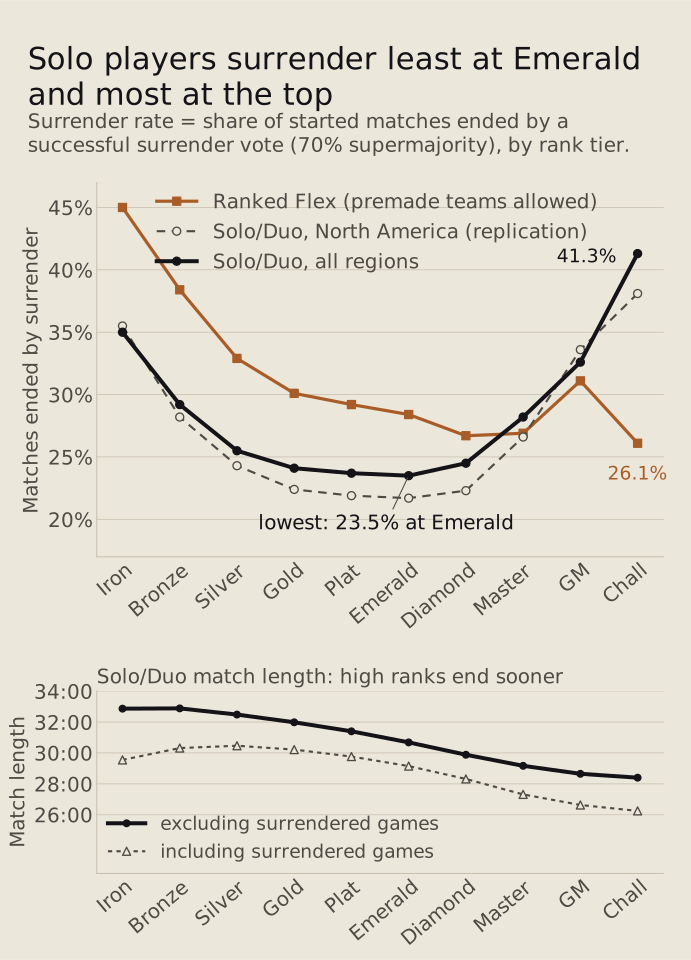
Fig. 1 here; Figure 3 in the paper. The crossing. Version string 16.19 is Riot's player-facing patch 26.19 ~ a reader checking the notes for 16.19 finds nothing. All regions, 3,053,122 matches over a rolling two-day window, pulled 2 October 2026; the sample is the window, not the patch, and the source publishes no sampling frame. The North American replication plotted alongside is 336,025 matches, 7 October. The widest gap is 15.2 points at Challenger, where NA Flex caps at 50 slots against Solo/Duo's 300; reported as the widest cell, not as the finding. One inconsistency reported rather than resolved: the figure states the surrender threshold as a 70% supermajority, the prose as four of five, and the sources give both.
- Riot on its own limits. It has never claimed the capability to detect non-verbal camp theft, and declines to specify what the system looks for. The one accuracy figure it has published is around 70% against a stated 95% minimum, August 2024, with no false-positive rate. Its reform percentages ~ the 50/70 pair, and a 74% elsewhere ~ are unpublished, without methodology or controls, and contradict each other across sources.
- The contract. Esports Global Code of Conduct, 2025–26 edition: Art. 4.2 underperformance, Art. 4.14 manipulation, Art. 5.2 truth and adverse inference. Always cite the edition: 4.14 and 5.2 were 3.14 and 4.2 in 2024, so a bare “4.2” names two different articles depending on the year. The truth-duty wording is identical across all three editions ~ the one safe cross-edition sentence. Terms of Service searched in full.
- Riot on its own detection. Quick LoL Thoughts: Game-Ruining Behavior Part 2, June 2020: detection "too basic, over-relying on things like raw number of deaths per game and player reports," and players "skirt the line repeatedly."
- Hard facts and norms. Grimmelmann, The Virtues of Moderation, 61, 65 ~ software suits decisions on "hard" facts; norm-setting is moderation's biggest challenge.
- Clearing against convicting. Blackburn and Kwak, STFU NOOB! ~ on Tribunal cases, overwhelming-pardon decisions predicted at AUC .88, overwhelming-punish at .75. Their influence-point account is the per-verdict reward cited in Proposal.
- Theft flagged elsewhere. Chen et al. 2023, a visual-analytics system built with Tencent game experts: rule-based flags for lane and jungle stealing among six griefer types. It says nothing about what Riot runs.
- Who can read a match. Cook et al., "For Whom" 300, 308, 310 ~ on player chat, unspecialised human coders and validated dictionaries barely agreed: r = .33 on emotional valence, r = .01 on low communion.
- Selecting for ambiguity. Kordyaka et al. 397:15–16 ~ punished players moved to acts with no punishment in place, being "quite resourceful in finding specific ways of annoying others that were not currently punished." The same page records perpetrators who "rally other teammates to falsely report the victim" (397:15).
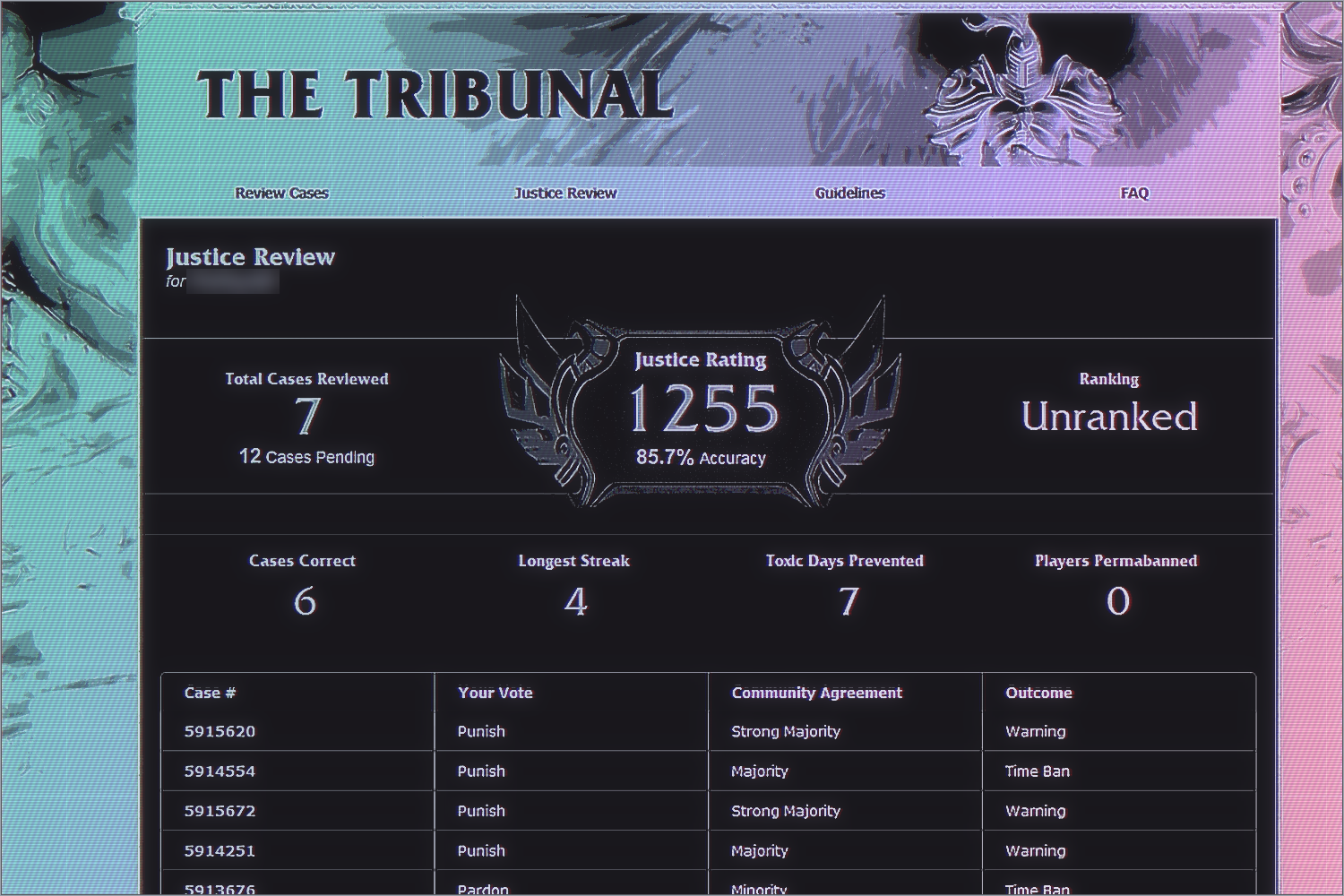
- The Tribunal. May 2011 to 2014, level 20 and up, twenty cases a day. Deliberation was forbidden by design, which Riot stated as a design goal; jurors organised on the forums anyway. It was not unpaid: voting earned five influence points, awarded only on a majority verdict.
- Exit and voice. Hirschman ~ exit and voice are substitutes, cheap exit atrophies voice, and exit is taken disproportionately by the most quality-conscious members, so it selects an organisation's membership rather than disciplining it. With the retention figures below, that is the selection claim in Outcome.
- The test, as built. Riot's match-v5 API, 9,140 calls, account IDs pseudonymised at the pull (HMAC-SHA256, NIST SP 800-188); SQLite, rebuilt by script from the raw records; the measures as SQL views; three games recomputed by hand from the raw records, with no differences. Design, sample and tail were fixed in the study plan before the full pull. Aggregates only: no player, account or match is published.
- Retention. Grandprey-Shores et al. 1363 ~ harassed new players leave, β = −.351, while a player's own high toxicity predicts they keep playing, β = .640.
Edges
- Sworn ~ the same work at professional stakes, with a named client. This entry takes apart somebody else's governance. That one builds governance.
- It generalises past Riot. Valve shipped peer review for griefing in Dota 2 in 2021 and it still runs ~ with no case file, no reasons and no appeal. When Valve brought players back into Counter-Strike in 2026 it kept them as labellers and withheld the judgment. The function studios fund is monitoring. The function they do not fund is contestable accountability.
- The counterargument pass. The concede-then-turn structure throughout came out of that pass rather than being chosen in advance ~ the objection that survived hardest is the one Proposal opens by conceding.
- Where the method runs out. Flow theory has no account of other people, so the argument hands off to Huizinga for the play-community and Ostrom for what keeps a fragile voluntary order alive. I keep Ostrom's own hedge: she declined to call her principles necessary conditions, so the claim is correspondence, never proof.
- Provenance. Proposal and Test are mine, not the paper's ~ the paper stops at the diagnosis and Ostrom's arena; the proposal is built from its sources and checked against them in a chorus pass. The sanction was a temporary suspension; the paper records only removal from the match environment. The match is recalled testimony from roughly five years ago. No screenshot, no match ID, levels approximate, and the jungle mechanics described are how they worked when I played rather than how they work now.